
Quick show of hands….who would rather talk about robot design, mission difficulty and robot game strategy instead of digging in and building with Legos? If you raised your hand, you’re crazy. I suppose there is some small chance that you had a valid reason for raising your hand…nah, you’re just plain crazy. If you are normal and did not raise your hand , get ready for some good news.
But first the bad news….you really should make sure you understand why robot design, mission assessment and overall robot game strategy are important. Here are a few reasons and I am sure you can think of more:
- Robot judges like to ask you about those things so it is good to be conversant in them.
- It really does save time in the overall scheme of things.
- “If you don’t know where you’re going, you’ll end up someplace else.” –Yogi Berra
You may have also noticed that the FLL Kickoff presenters made it a point to demonstrate how the process of solving problems is an important thing they want you to focus on this year. What you may not have noticed, however, is that the process for the team project and the process for the robot game are the same. Engineers don’t have great imaginations so they call it the “Engineering Design Process.” The engineering design process is probably very similar to the way you already solve problems. In its simplest definition, it is just a set of steps to guide your from a problem ( your starting point ) to a solution ( your ending point ). It is designed to encourage teamwork, creativity, and practicality in the problem solving process. There are many versions of what the engineering design process is but we’ll reference this one since it is the one used in the Hydro Dynamics Challenge Guide.
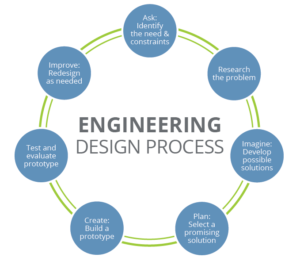
This particular version of the engineering design process breaks it down into 7 stages. We call them stages because you will notice the picture shows them all in a circle to demonstrate that this process is iterative. It is not simply a set of steps that we follow from start to end. One important thing to note is that the process can be applied to a problem of any size. For example, we applied the process to design the robot and yet we will apply the same process to solve the bigger problem of solving the robot game.
The stages of the process are pretty intuitive to understand. The real power – and the thing that makes great engineering – comes from looping around the wheel often. Each iteration should make your solution more complete and more robust.
While it isn’t necessary to know all of the stages from memory, it is true that All Robot Innovation Precedes Cookie Time Immediately.
By now, you’re probably starting to think that the good news I promised at the beginning of this was just a cruel hoax to see how far I could get you to read. Not so – the time has come for the good news. This weeks robot fun will start with a little challenge – one question for each of you to test your understanding of the engineering design process. You may ( and very well should ) consult your team members for answers. You can probably even study over this page one more time to prepare for your challenge. ***Good News Alert*** Once the team passes the test ( and I am sure you will get 100% ), you will be unleashed on the Create and Test stages…otherwise known as build with Legos.
COOKIES!